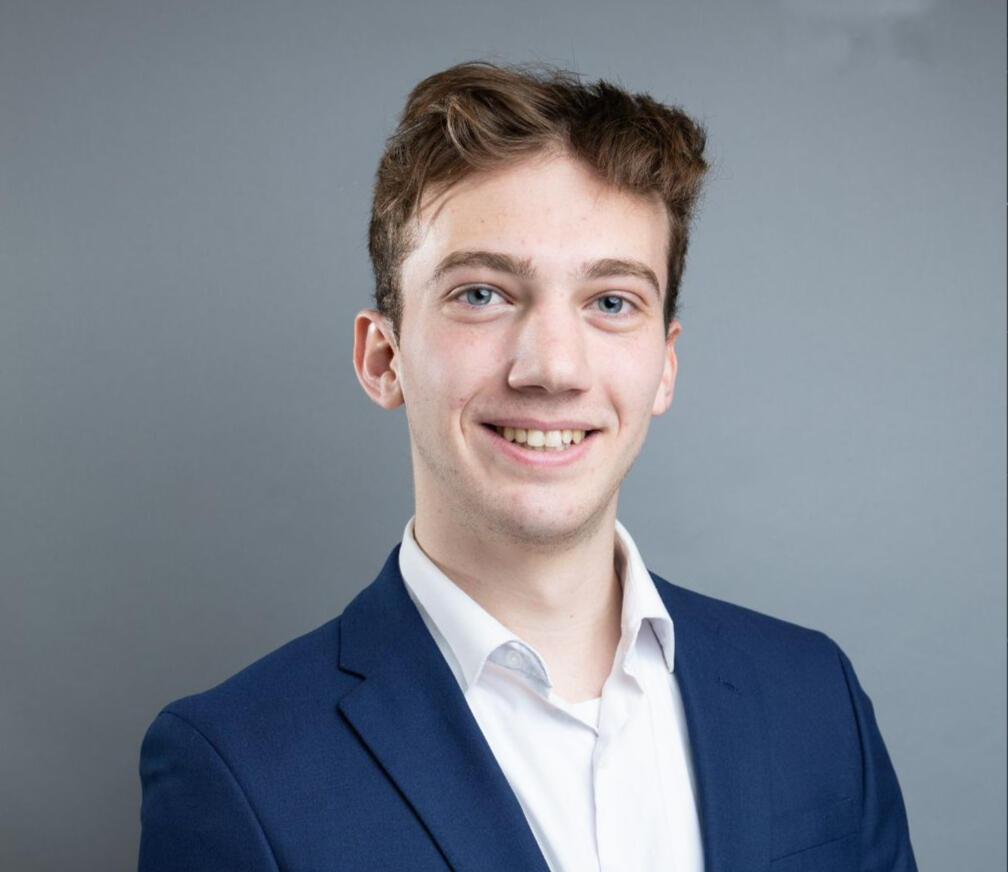
Cameron Cummins


Composer, Theorist, and Conductor
B.M. UCF 2026

(Last Updated 5/20/2026)

About

Cameron Cummins (b. 2004) is an emerging music theorist and composer based in Orlando, FL, and Philadelphia, PA. His theoretical research focuses on ludomusicology, computational musicology, and corpus analysis, utilizing quantitative frameworks to study style, timbre, harmony, and rhythm. His recent scholarship includes presentations at the 2026 Society for Music Theory (SMT) Annual Meeting, the North American Conference on Video Game Music (NACVGM) and Music Theory Southeast (MTSE), among others.As a composer, Cameron writes music spanning genres and traditions for both classical and jazz ensembles. His compositions have been commissioned and performed by the International Trombone Summit, loadbang, the Brevard Music Center, and the Heidelberg New Music Festival. Deeply committed to inclusivity, he has also collaborated with the Florida Music Educators Association to create experiences that promote equitable music-making for all learners.Cameron is an inductee of the Order of Pegasus (the University of Central Florida’s highest student honor) as well as a Presser Scholar and a National Merit Scholar. He is currently pursuing his undergraduate degrees at UCF, where his principal teachers and mentors include Dr. William R. Ayers, Dr. Alexander Burtzos, and Dr. Christine Lapka. He is a member of ASCAP and SMT.


Headshots

Contact

Want to get in contact? Use this form to send questions, messages, commission requests, performance/purchase requests, reporting a performance, etc.
I'll respond as soon as I can!

Creative Work


Large Ensemble

TitleInstrumentationYearDurationScore
ChannelsOrchestra, Chamber Orchestra, Chamber Winds20254'30'' 
Vötn og VindurOrchestra20258'00'' 
The MatterhornConcert Band (with varied-ability parts)20243'30''Score/MIDI
To Soar Above the CloudsSymphonic Band20242'30''View
Black NileBig Band & Little Big Band20225'00''View
Dear Old StockholmBig Band20224'30''MIDI
Dash!Chamber Wind Ensemble20214'30''MIDI

Chamber

Good Planets are Hard to FindPercussion Trio + Fixed Media20255'15'' 
Portraits of a PersonPercussion Trio20257'00'' 
The CharmFlute, Clarinet, Percussion, Four-Hand Piano, 2 Violins, Cello202410'00''View
The Phosphorus SunSaxophone Quartet202313'00''View
CuriositiesBaritone Voice, Trumpet, Trombone, & Bass Clarinet20233'00''View
/per/Flute, Clarinet, Violin, Cello, 2 Percussions, & Piano20235'30''View
Wintry5 Trombones / Brass Quintet20226'00''View
Fanfare for Five Trombones5 Trombones20211'30''View

Solo

PleiadesTrombone and Piano20266'00'' 
Chromatic in E minorPiano Solo20251'30'' 
A Lunar AnamnesisAlto Saxophone Solo20246'00''View
Reminiscent LinesTenor Voice & Piano202410'00''View
FalloutViolin Solo20237'00''View
A River's JourneySolo Cello & Piano20228'30''View

In Progress/Planned

  • Summer 2026: A Crimson Flame for String Orchestra & Boom Whackers for Innovation High School (IP)

Academic Publications & Projects


Refereed Conference Presentations

Temporal Determinacy and Negative Affordance in
Wii Sports Resort (2009)
(Click to expand)

Recent ludomusicological scholarship has explored how music shapes possibilities for play (Grasso 2024a; Summers 2016; Summers 2021). Julinane Grasso’s spectrum of ludonarrativity positions games between narrative-driven progression and rules-based interpretation (Grasso 2024b), but less attention has been given to how musical parameters, such as tempo, texture, timbre, and rhythmic articulation, shift as soundtracks move from narrative to ludic contexts. William Gibbons (2014) has shown that prolonged absence of non-diegetic music can disrupt immersion and shift narrative perspective, yet the role of music when play is governed by rules rather than story remains underexplored. Drawing on Erick Verran’s (2021) concept of negative affordance, this paper argues that as music becomes less texturally dense and less rhythmically structured, the responsibility of timing musical events shifts from the composer to the player, increasing negative affordance. Using minigames from Wii Sports Resort (2009) as case studies, this paper maps temporal determinacy across varying degrees of ludonarrativity. Swordplay: Showdown, the most narratively framed, features dense non-diegetic music in 4/4, harmonically static in A minor, with layered drums, brass, and strings that adaptively respond to player health and actions. Temporal determinacy is high: periodicity is composer-imposed, and hypermetric articulation varies across phrase lengths. Swordplay: Duel occupies a middle position, reducing music to a drum groove mixed with environmental sounds. Here, temporal grids remain, but textural saturation and harmonic support are not present, increasing player influence on event timing. Archery represents the most ludic scenario: non-diegetic music is absent, leaving ambient environmental sounds and player-generated arrow releases to define temporal organization. Without composer-imposed metric or harmonic cues, players assume responsibility for articulating musical time, creating heightened negative affordance. Across these examples, reductions in structured rhythm and textural saturation progressively increase negative affordance. By tracing these musical changes along the ludonarrative spectrum, this paper demonstrates that silence and textural sparsity in ludic contexts do not signify loss but rather enable focused, rule-aligned action. The findings suggest that in games, reductions in musical determinacy can function as a design resource, evolving player experience and agency through temporal control.


Included Figures & Captions

  • Figure 1: Grasso’s Ludonarrative Spectrum (2024) graphed as a function of temporal determinacy.
  • Figure 2: Minigames from Wii Sports Resort plotted along Grasso’s Ludonarrative Spectrum (2024) as a function of temporal determinacy.
  • Figures 3–5: Rhythmic and structural transcriptions of Swordplay (Showdown & Duel) and Archery.

Selected Bibliography

Gibbons, William. “Wandering Tonalities: Silence, Sound, and Morality in Shadow of the Colossus.” In Music in Video Games: Studying Play. Routledge, 2014.

Grasso, Julianne. “Ludomusical Narrativity: Sound and Music as Structures of Play.” In The Oxford Handbook of Video Game Music and Sound. Oxford University Press, 2024.

Verran, Erick. “Negative Ecologies, or Silence’s Role in Affordance Theory.” Journal of Sound and Music in Games 2, no. 4 (2021): 36–54.


Presented At

Society for Music Theory Annual Meeting, Milwaukee, WI, November 5-8, 2026.

From Lap to Map: How Musical Scale, Place, and Play Drive the
Interconnected Mario Kart World
(Click to expand)

Deserts, castles, and ghost houses— Super Mario’s environments are whimsical and charming, but why are they so compelling, and what happens when our analysis extends beyond individual levels to worlds or even entire games? Drawing on Cresswell’s theory of place (2014) and recent work on musical place-building in Mario Kart 8 (Heazlewood-Dale, 2024), I propose a spectrum between localized and globalized scale in games. As game environments become increasingly globalized, the music may similarly be affected. Consequently, players encounter a broader, less musically congruent sense of place. This leads to different “affective energies” and potential interactions compared to those in localized environments (Grasso, 2024). Using Mario Kart World as a case study, I apply a mix of qualitative and quantitative musical analysis to demonstrate that the game’s Free Roam mode produces a uniquely globalized sense of place through its trans-environmental musical “radio.” Employing statistical modeling, musical congruency, and transformational media analysis (Grasso, 2024; Summers and Farmer, 2023), I argue that the affective potential (“sense of play”) in Free Roam becomes more exploratory than that of other modes because of its more globalized sense of place. In doing so, I adopt the developers’ term “interconnected world” to describe games with this globalized structure. By plotting interconnected worlds, open worlds, and level-based video games along a continuous spectrum from localized to globalized senses of place and play, this paper offers a new framework to demonstrate that games produce differing musical-spatial coherence across environments of various scales.


Included Figures & Captions

From Map to Lap: The Webpage

Selected Bibliography

Heazlewood-Dale, James C. “Piranha Plants, Volcanoes, and Turtle Shells: Sound, Music, and Place in Mario Kart 8 Deluxe’s Fantastical Environments.” In Video Games and Environmental Humanities: Playing to Save The World. Edited by Kelly I. Aliano and Adam Crowley (Cham: Springer International Publishing, 2024).

Cresswell, Tim. Place: An Introduction (John Wiley & Sons., 2014).

Lavengood, Megan and Evan Williams. “The Common Cold: Using Computational Musicology to Define the Winter Topic in Video Game Music.” Music Theory Online 29, no. 1 (2023).


Presented At

Honors Undergraduate Thesis — LINK

North American Conference on Video Game Music, Rensselaer Polytechnic Institute, Troy, NY, May 2, 2026.

Florida State University Music Theory Forum, Florida State University, Tallahassee, FL, March 6, 2026.

Music Theory Southeast, Undergraduate Research Fair, Morehouse College, Atlanta, GA, February 28, 2026. (Poster)

Multiple Abilities in One Ensemble: How Do You Do That?(Click to expand)

Discover a groundbreaking approach to inclusivity in educational music! Join us for an enlightening session introducing the concept of flexible instrumentation and varied-ability parts in educational music. In this session, you’ll experience the premiere of a dynamic new piece and engage in a discussion on how to build a program focusing on inclusivity using this methodology. Ideal for high school bands, orchestras, choirs, and community or university ensembles, this session promises to expand the boundaries of musical inclusion. Explore how individuals of all abilities can contribute meaningfully, with every part carrying significance. Don’t miss this opportunity to embrace a more inclusive future in music!


Presented At

Florida Music Educators Association Conference, Tampa, FL, January 10, 2025. Co-presented with Christine Lapka.

Invited Presentations & Public Engagements

Creating Chaos: Distracting Music for One Player in
Keep Talking and Nobody Explodes (2015)
(Click to expand)

The gameplay of Keep Talking and Nobody Explodes (2015) relies on a fundamental musical imbalance: one player, the “bomb defuser,” is placed in a landscape of escalating musical tension, while the “experts” remain in the comparatively silent real world and use a physical manual to guide the defuser. Drawing on William Ayers’s theory of musical distraction (2020) and Tim Summers’s “playful listening” (2021), I propose a theory of secondary musical distraction. As the defuser listens playfully to the increasingly distracting music, their growing cognitive load creates less coherent exchanges of information. Consequently, the "affective energies" (Grasso 2024) experienced by the group descend from a coordinated “team identity” into disarray (Séguin 2025). I argue the musical distraction experienced by the defuser spreads secondarily to the experts through communication, and that the ensuing breakdown is central to the game's appeal. I investigate the seven musical tracks in Keep Talking and Nobody Explodes by extracting their Root Mean Square (RMS) energy and plotting their dynamic musical layers (Collins 2007) over time, demonstrating that acoustic intensity increases with gameplay urgency. A popular Twitch streamer’s gameplay transcripts likewise show linguistic markers of stress (including speech rate, repetition, profanity, and sentiment polarity) spiralling across each round. Together, these analyses frame the music as an “unreliable musical narrator,” luring the defuser into a false sense of security before rapidly escalating toward chaos and secondarily distracting the experts. This paper thereby introduces a new framework to demonstrate that musical distraction can sabotage collaborative play in local multiplayer environments.


Included Figures & Captions

Creating Chaos: The Webpage

Selected Bibliography

Ayers, William. “A Theory of Music as Distraction in Video Games.” North American Conference on Video Game Music (Conference Presentation, June 13, 2020).

Summers, Tim. “Fantasias on a Theme by Walt Disney: Playful Listening and Video Games.” In The Oxford Handbook of Cinematic Listening. Edited by Carlo Cenciarelli (Oxford University Press, 2021).

Séguin, Nicholas. “Functions of Sound in Distributed Collaborative Games.” Journal of Sound and Music in Games 6, no. 2 (2025): 83–95.

White, Christopher. The Music in the Data: Corpus Analysis, Music Analysis, and Tonal Traditions (Routledge, 2022).


Presented At

UCF Student Scholar Symposium, forthcoming, Spring 2027. Invited Poster.

UCF Summer Research Showcase, July 17, 2026. Invited Poster.

Supported by the UCF Summer Undergraduate Research Fellowship.

Video Game Music Teaches Us to Listen(Click to expand)

We usually think of listening as simply receiving sound, but video games show us that listening can also mean imagining what else that sound could be. In many games, music reshapes itself based on our choices, training us to expect variation and to imagine alternative versions of a moment. Tim Summers calls this the “potential to be otherwise.” I believe this mindset of “playful listening” can transform how we understand people. It encourages us to pause and reflect before assuming motives. In fact, playful listening helps us combat a sociological bias called fundamental attribution error, which is the tendency to assume a person’s behavior reflects who they are rather than the situation they’re in. Students will leave with the idea that playful listening isn’t just for playing games; it’s a pragmatic tool to better understand people and engage more thoughtfully.


Selected Bibliography

Summers, Tim. “Fantasias on a Theme by Walt Disney: Playful Listening and Video Games.” In The Oxford Handbook of Cinematic Listening. Edited by Carlo Cenciarelli (Oxford University Press, 2021).


Presented At

TEDx Talk, University of Central Florida, Orlando, FL, April 17, 2026.

In Progress/Planned

Hearing Multiple Truths: Topic Divergence, Bayesian Prediction, and the Rashomon Effect in The Afterparty (2022):
Using Bayesian methods to model narrative structures in media, this project develops a statistical framework for predicting categorical response variables in complex narrative arcs. Planned for Winter 2026.